
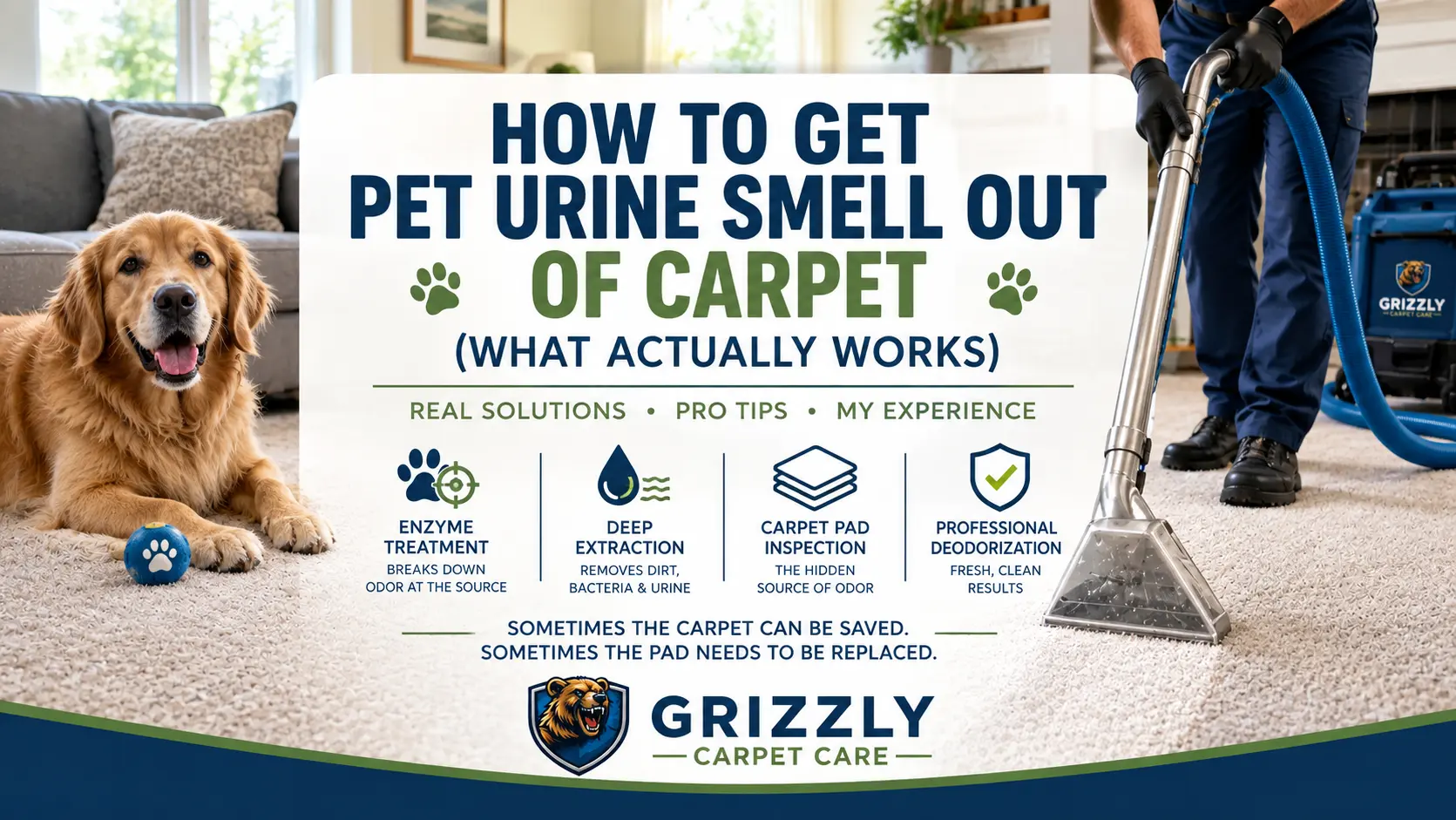
Pet urine is one of the most common — and one of the most difficult — carpet problems we deal with as professional carpet cleaners.
If you have a dog or cat, you probably know the situation. You clean the carpet, the room smells better for a while, and then a few days later, especially when the room gets warm or humid, that familiar smell comes back.
So what actually works?
The short answer is: pet urine odor has to be treated at the source, not simply covered up.
As a professional carpet cleaning technician, I have worked on a lot of homes with pet odor problems. Some jobs have a very happy ending. Others teach us an important lesson: sometimes the carpet is not the only thing that needs attention.
Why Does Pet Urine Smell So Bad?
When pet urine is fresh, it can often be cleaned relatively easily. The problem is when urine sits in the carpet and penetrates deeper.
Urine can move through the carpet fibers and backing and eventually reach the carpet pad underneath. In more severe cases, it can even reach the subfloor.
This is where things get complicated.
A regular carpet cleaning can remove dirt, oils, and a large amount of contamination from the carpet fibers. But if urine has soaked into the pad underneath, cleaning only the surface of the carpet may not completely solve the odor.
This is why simply spraying a deodorizer over the carpet usually isn't enough.
If the source of the odor is still there, the smell can come back.
Enzyme Treatment: What Actually Helps
For pet urine problems, we often use specialized enzyme-based pet odor treatment.
The purpose of an enzyme treatment is different from simply using a normal carpet cleaning detergent. Enzyme products are designed to break down the organic components associated with pet urine rather than simply masking the smell.
But there is an important part that homeowners sometimes don't realize: enzyme treatment needs time to work.
A professional doesn't just spray something on the carpet and immediately extract it. Depending on the situation, we may apply the treatment, give it appropriate dwell time, and then proceed with the cleaning and extraction process. After extraction, additional odor treatment and deodorization may be necessary.
The exact process depends on how severe the contamination is, how old it is, the type of carpet, and how far the urine has traveled.
A Recent Job in Tumwater
One of my recent customers was an incredibly sweet older lady in Tumwater. She had a beloved pet who was already very old and sick. Unfortunately, over time, there had been enough accidents that she thought her carpet was basically ruined.
She contacted us because she was worried that the carpet might be beyond saving.
We cleaned the living room and bedroom and treated the areas specifically for pet odor. We used an enzyme-based treatment, a professional odor-removal product, and then followed up with deodorization. The result made her extremely happy.
That is one of my favorite parts of this job. Sometimes a customer has already convinced themselves that something needs to be replaced, and after professional treatment, they realize that the carpet can still be saved.
There is also an important difference in price. Pet urine treatment is not the same service as a normal carpet cleaning. It requires specialized products, additional treatment, and more time. For this particular job, the two rooms were $230 compared with $160 for a standard cleaning.
The extra cost wasn't simply for "a stronger cleaner." It was for the additional treatment and labor required to properly address the odor problem.
But Sometimes Cleaning Isn't Enough
I also had a very different experience with a customer in Centralia. A young couple had recently purchased a house and noticed a persistent urine smell coming from one room.
Replacing the carpet wasn't something they wanted to do immediately because a new carpet can be expensive. They decided to try professional cleaning first. At the time, we weren't regularly working in Centralia, but someone in Olympia had recommended us to them.
Before starting, I explained something I always tell customers with serious pet odor problems:
I can give you my best professional treatment, but I cannot guarantee that cleaning will completely remove the odor if the contamination has reached the padding or subfloor.
We applied the treatment and allowed it to dwell properly. After extraction, we treated the area again and performed deodorization. At the end of the job, we thought we had made a significant improvement — and initially, it seemed like we had.
But I always like to follow up with customers after a difficult odor job. About a week later, I contacted the customer and asked how everything was going. He told me the room was much better — actually, a lot better — but every once in a while, the odor seemed to come back.
That was an important clue. I recommended that they lift the carpet and inspect the padding underneath. They did exactly that.
The carpet pad was holding the odor. They replaced the affected padding, and after that, the odor was completely gone.
That is a perfect example of why pet urine problems can be complicated. Sometimes the carpet is the problem. Sometimes the pad is the problem. And sometimes the contamination can go even deeper.
Carpet Pad Can Hold a Lot of Odor
The carpet pad underneath your carpet is basically a sponge. If a pet repeatedly urinates in the same area, the urine doesn't necessarily stop when it reaches the carpet backing. It can continue into the pad.
And if the pad becomes heavily contaminated, cleaning the carpet itself may only provide a temporary improvement. This is one reason why a room can smell perfectly fine immediately after cleaning but start smelling again later — as the carpet dries completely, or when humidity and temperature change, odor that remains underneath can become noticeable again.
In severe cases, the correct solution may involve:
- Professional carpet cleaning
- Enzyme treatment
- Odor treatment
- Professional deodorization
- Removing and replacing contaminated carpet pad
- Cleaning or treating the subfloor
- In extreme situations, replacing the carpet itself
The right solution depends on how far the contamination has traveled.
Can You Remove Pet Urine Smell Yourself?
Sometimes, yes. If you catch an accident quickly, blotting up as much liquid as possible and using an appropriate pet-urine treatment can make a big difference.
The problem is usually older or repeated contamination. One of the biggest mistakes I see is trying to solve a serious urine odor problem by repeatedly applying more and more household carpet products. That can sometimes make the situation worse by adding additional moisture or chemicals without actually reaching the source of the odor.
Another common mistake is trying to cover the smell with fragrance. A carpet that smells like flowers and urine is still a carpet with a urine problem.
The goal should be odor removal, not odor masking.
How We Approach Pet Odor Problems
When we arrive at a home with a pet odor issue, the first thing we try to understand is the extent of the problem. We look at things like:
- How old is the contamination? Fresh accidents are generally much easier to deal with than years of repeated contamination.
- Is the odor localized or throughout the room? A few isolated areas can be very different from a room where a pet has repeatedly had accidents.
- Has the carpet already been treated with household chemicals? Previous products can affect how professional treatments work.
- Could the urine have reached the pad? This is one of the most important questions.
From there, we choose the appropriate cleaning and odor-treatment process. There is no magic spray that works perfectly on every pet urine problem. A good technician has to understand what is happening underneath the carpet — not just what the carpet looks like from above.
When Should You Consider Replacing the Carpet?
Carpet replacement should not necessarily be the first option. If the carpet fibers and backing are still in good condition and the contamination is manageable, professional cleaning and treatment may save the carpet.
But if urine has heavily saturated the pad or reached the subfloor, replacement of the pad — and sometimes additional treatment underneath — may be the better long-term solution.
That's why I always prefer to be honest with customers rather than promise something I can't guarantee. Sometimes we can make a huge difference with professional treatment. Sometimes we can completely solve the odor. And sometimes we can improve the situation significantly, but the contamination underneath the carpet needs to be addressed separately.
The Bottom Line
If your carpet smells like pet urine, don't immediately assume that the carpet has to be replaced. A professional enzyme treatment, deep extraction, odor treatment, and deodorization can often make a major difference, especially when the contamination hasn't penetrated too deeply.
But if the odor keeps coming back after professional cleaning, don't automatically assume the cleaning "didn't work." It may be telling you something important: the source of the odor may be underneath the carpet. That could mean the carpet pad — or in more severe cases, the subfloor — needs to be inspected.
After working on many pet odor jobs, one thing I've learned is that every situation is different. My goal isn't just to make the room smell better when we leave. It's to figure out where the odor is coming from and choose the treatment that gives the carpet the best chance of staying clean and fresh. And if I don't think cleaning alone will solve the problem, I'll tell you that too.
Honest advice is part of professional carpet cleaning.
Quick Answers
Why does pet urine smell come back after carpet cleaning?
Because the odor source can be deeper than the carpet surface. Urine can soak through the backing into the pad, and in severe cases the subfloor. Surface cleaning improves it, but if the pad is contaminated the smell can return as the carpet dries or when humidity and temperature change.
Does professional carpet cleaning remove pet urine smell?
Often yes, especially when the urine hasn't soaked deep into the pad. We use an enzyme treatment, deep hot-water extraction, and deodorization. If the odor has reached the pad or subfloor, those may need to be addressed separately.
What is enzyme treatment for pet urine?
An enzyme-based product breaks down the organic components of urine instead of masking the smell. It needs proper dwell time to work, then we extract and deodorize, targeting the odor at its source rather than covering it up.
Can I get pet urine smell out of carpet myself?
For a fresh accident, blot up as much liquid as possible and use a proper pet-urine treatment. Older or repeated contamination usually needs professional treatment. Avoid piling on household products or fragrance, which masks the smell instead of removing it.
Grizzly Carpet Care provides professional pet stain & odor removal and carpet cleaning across Olympia, Lacey, Tumwater, Tacoma and the surrounding South Sound. Call or text (253) 355-5109 for a free quote.